Jerusalem: A City That Fills the Heart With Joy — and Prayer

Robert Fetterhoff • March 11, 2026

A reflection from Pastor Bob Fetterhoff

One of the most meaningful moments of our Fall 2025 Holy Land tour came on the day we arrived in Jerusalem.


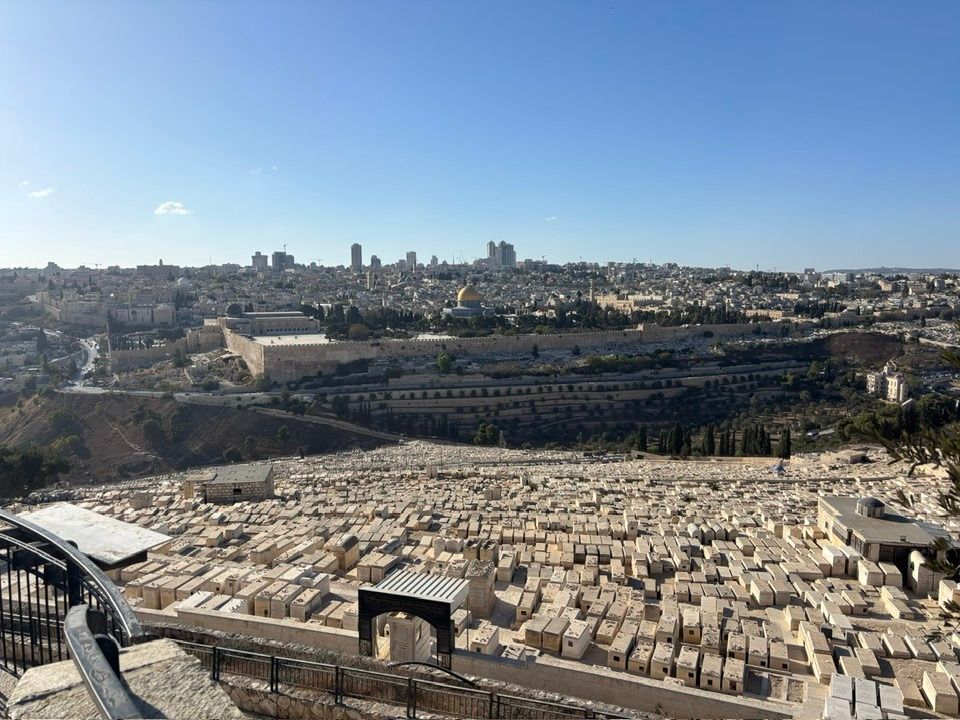
I remember sitting just outside the walls of the Old City, looking toward Jaffa Gate. From that vantage point you can see the massive stone wall stretching south and west around the ancient city. Just nearby stands the Tower of David and the Citadel Museum, and beyond that rise the spires of several churches. In the distance, you can even see the Mount of Olives.


One of the most meaningful moments of our Fall 2025 Holy Land tour came on the day we arrived in Jerusalem.


I remember sitting just outside the walls of the Old City, looking toward Jaffa Gate. From that vantage point you can see the massive stone wall stretching south and west around the ancient city. Just nearby stands the Tower of David and the Citadel Museum, and beyond that rise the spires of several churches. In the distance, you can even see the Mount of Olives.


Jerusalem has a way of stirring the heart the moment you arrive.


Every time I come here, I experience two emotions at once.


On the one hand, there is great joy. I love this land. I love walking through the places where the events of Scripture unfolded. Being here brings the Bible to life in ways that are difficult to describe.


But at the same time, there is also a deep sadness.


Jesus himself expressed that same emotion as he looked over this city from the Mount of Olives. In the Gospel of Matthew he said:


“Jerusalem, Jerusalem, you who kill the prophets and stone those sent to you, how often I have longed to gather your children together, as a hen gathers her chicks under her wings, but you were not willing.”


Jesus went on to say something sobering:


“Your house is left to you desolate.”


Those words became painfully true throughout history.


In 70 A.D., the Romans invaded and destroyed Jerusalem. Decades later, after another revolt, the city was burned again. The Roman emperor Hadrian even renamed the region Syria Palestina, intentionally removing references to Israel and the Jewish people from the name of the land.


For nearly 1,900 years, the land was known by that name.


But history took a remarkable turn in 1948, when the modern state of Israel was reborn. Since that time, the land has flourished again in extraordinary ways—agriculturally, economically, and culturally.


When you travel through Israel today, you see that renewal everywhere.


Yet Scripture reminds us that something even deeper still lies ahead.


The prophet Ezekiel describes a time when the people first return to the land, and then God gives them a new heart. In other words, the physical restoration of the land comes first, followed by a spiritual awakening.


Standing there in Jerusalem, looking at those ancient walls, that promise came to mind again.


The land has come back to life.


But the greater prayer is that the people will come to faith.
That is why Jerusalem does more than inspire admiration—it calls us to pray.


To pray for Israelis and Palestinians.

To pray for peace in the land.

And most of all, to pray for spiritual awakening.


As our group stood in Jerusalem that day, we were also mindful of the tensions and heartbreak that still affect the region. Families were grieving. Communities were waiting for loved ones to return. The realities of conflict and uncertainty remain very present in daily life.


Moments like that remind us that the deepest peace this world longs for will ultimately come only through the Prince of Peace.


Until that day, we pray.


We pray for healing.

We pray for reconciliation.

We pray that many in this land will come to know Jesus.


And for those of us who had the privilege of standing there together, that moment became a powerful reminder of why journeys like this matter.


Walking through the land of the Bible doesn’t just deepen our understanding of Scripture.


It also deepens our compassion for the people who live there today.
By Robert Fetterhoff March 11, 2026
Over the past several days, the situation in the Middle East has continued to develop rapidly. What began with coordinated strikes against Iran has now become one of the most significant geopolitical moments in recent years, and people around the world are watching closely. As believers, moments like this naturally raise questions. What does this mean for the future? How should we understand these events? And most importantly, what does Scripture say about times like these? The Bible does not give us a day-by-day explanation of current events, but it does give us a framework for understanding the world when tensions rise and nations move toward conflict. An Unusual Moment During the Feast of Purim Interestingly, these developments have unfolded during the Jewish festival of Purim, a holiday that commemorates one of the most remarkable deliverances in Jewish history. Purim remembers the events recorded in the book of Esther, when the Jewish people living under Persian rule faced a plot to destroy them. A powerful official named Haman sought the elimination of every Jewish man, woman, and child throughout the Persian Empire. Yet through the courage of Queen Esther and the unseen providence of God, the plan was overturned and the Jewish people were preserved. Purim ultimately celebrates the truth that God protects His covenant people and works behind the scenes of history. It is difficult not to notice the timing of recent events as that ancient story is being remembered around the world. For many observers, the developments in Iran over the past few days feel strikingly significant. But whether events unfold quickly or slowly from here, the deeper lesson remains the same: God is still sovereign over history. The World’s Attention Turns Again Toward Israel Jerusalem has long been the focal point of global tension, and Scripture tells us that this will continue to be true. The Bible describes a time when the nations of the world will increasingly focus their attention on Israel and Jerusalem. The prophet Zechariah writes that Jerusalem will become “a cup of trembling” for the nations. The psalmist asks in Psalm 2, “Why do the nations rage and the peoples plot in vain?” Jesus himself warned that the period before His return would include wars and rumors of wars, along with increasing turmoil among nations. For those who follow Scripture closely, the tensions we see today remind us that history is moving toward a future that God has already revealed in His Word. Developments on the Ground Reports from the past 48 hours indicate that military operations have significantly impacted Iran’s missile infrastructure and military capabilities. According to several sources, a large portion of Iran’s ballistic missile supply has been destroyed, and hundreds of strategic targets connected to missile systems, air defenses, and military leadership have been struck. While the situation remains fluid, many observers believe the coming days may determine whether the Iranian regime continues to hold power or whether internal pressure leads to significant political change. At the same time, retaliatory strikes and regional tensions remind us that conflict always brings uncertainty and risk—especially for civilians who find themselves caught in the middle. That is why this moment calls not only for careful observation, but for earnest prayer. How Should We Respond? When the world feels unstable, Scripture calls believers to respond in ways that are very different from the reactions we often see in public discourse. We respond first by trusting God. Proverbs reminds us: “Trust in the Lord with all your heart and lean not on your own understanding.” In times when the future feels uncertain, that command becomes especially meaningful. We also respond by praying. Pray for innocent civilians throughout the region. Pray for wisdom for leaders making critical decisions. Pray for peace and restraint in moments when tensions could easily escalate further. And perhaps most importantly, pray for spiritual awakening. A Remarkable Spiritual Movement One of the most encouraging developments of recent years has been the growth of the Christian faith inside Iran itself. Despite decades of oppression and strict control by the government, the Gospel has quietly spread among the Iranian people. Some estimates suggest that millions of Iranians are now exploring the message of Christ, making the Iranian church one of the fastest-growing Christian movements in the world. In times of political upheaval, people often begin asking deeper questions about life, truth, and hope. And that is when the message of Christ shines most brightly. Remembering the Larger Story No one can say with certainty what the coming days or weeks will bring. But believers can rest in a truth that has remained constant throughout history: God is still in control. Empires rise and fall. Leaders come and go. Nations change direction. Yet through every generation, God continues to work out His purposes. In moments of uncertainty like this, we remember that history ultimately belongs to Him. We pray for peace. We pray for protection. And we pray that many people—throughout the Middle East and around the world—will come to know the One who alone can bring lasting peace. The day is coming when the Prince of Peace will reign. Until that day, we watch carefully, we pray faithfully, and we place our trust in the God who holds the future.
By Robert Fetterhoff March 11, 2026
In the past few days, the world has been watching the Middle East very carefully. The United States and Israel have launched coordinated military strikes against targets inside Iran, dramatically escalating tensions in a region that has already been under tremendous strain for many years. News reports continue to unfold, and many people are asking the same question: What happens next? Whenever events like this occur, it is important for believers to step back from the noise of headlines and consider what is happening through the lens of Scripture. An Interesting Moment on the Biblical Calendar One of the things that immediately came to mind when these events began unfolding is the timing. The Jewish festival of Purim is just around the corner. Purim remembers the events recorded in the book of Esther, when the Jewish people were living under Persian rule and faced a plot to destroy them. In that story, a powerful official named Haman attempted to orchestrate the destruction of the Jewish people. Yet through the courage of Queen Esther and the unseen providence of God, the plan was overturned and the Jewish people were preserved. Purim is ultimately a celebration of something deeper than a historical victory. It is a reminder that God is sovereign over history. Even when events appear chaotic or threatening, God is working behind the scenes in ways that human beings cannot always see. A Long and Difficult History The tensions involving Iran did not suddenly appear this week. For more than four decades, the Iranian regime has been involved in actions that have destabilized the Middle East and threatened both Israel and Western nations. Since the revolution in 1979, conflicts, proxy wars, and terrorist activity connected to Iranian influence have affected countries throughout the region. The military operation now unfolding is aimed at weakening the missile systems, nuclear capabilities, and military infrastructure that leaders believe could pose serious threats to Israel, American interests, and other allies in the region. Reports from the early stages of the operation indicate that a number of significant targets inside Iran have already been struck, and the situation continues to develop. As always in moments like this, the future remains uncertain. How Should Believers Respond? When world events feel unstable, it is easy for people to react with fear, anger, or speculation. But Scripture calls believers to respond in a different way. First, we are called to pray . Pray for those who are in harm’s way throughout the Middle East. Pray for innocent civilians whose lives are affected by decisions made by governments and military leaders. Pray for wisdom for those who are making difficult decisions during these tense days. But we also pray for something deeper. We pray for spiritual awakening. In recent years, there have been increasing reports that many people inside Iran are searching for spiritual truth and turning to Christ in surprising numbers. Even in the midst of political oppression and cultural pressure, the Gospel continues to spread quietly among people who are hungry for hope. Moments of upheaval sometimes become moments when people begin asking deeper questions about life, faith, and the future. And that is something believers can pray for with great hope.  Remember Who Holds History Throughout Scripture, God’s people lived in a world shaped by empires, wars, and shifting political alliances. Yet again and again, the Bible reminds us of a simple but powerful truth: God is still in control. Kings rise and fall. Nations change course. World events move quickly and sometimes unexpectedly. But none of it happens outside the knowledge and sovereignty of God. That is why believers can face uncertain times with both seriousness and hope. We pray for peace. We pray for protection. And we pray that many people—throughout the Middle East and around the world—will come to know the One who alone can bring lasting peace. Scripture reminds us that one day the Prince of Peace will reign. Until that day, we watch carefully, we pray faithfully, and we trust that God is still at work in the unfolding story of history.
By Robert Fetterhoff March 11, 2026
After a full day in Jerusalem, I stepped outside from my hotel room to look at the Old City—this time under the lights of night. It was nearly eight o’clock, and the city had taken on a completely different atmosphere. The massive walls of Jerusalem, built in the sixteenth century during the reign of Suleiman the Magnificent, were beautifully illuminated. The stone glowed softly in the evening light, wrapping around the Old City just as it has for centuries. From where I stood near Jaffa Gate, you could follow the path of the walls as they circled the city. Moving northward you would come to the New Gate, then Damascus Gate, and further along to Herod’s Gate. Continuing around the eastern side stands St. Stephen’s Gate, often called the Lion’s Gate. And then there is one gate that remains closed—the Golden Gate, also known as the Eastern Gate. Jewish tradition says that when the Messiah comes, he will enter Jerusalem through that gate. Scripture does not specifically say that, but the tradition has been strong for centuries. In fact, long ago a cemetery was built in front of the gate, an attempt by some to prevent such an entrance from ever taking place. But of course, when God accomplishes his purposes, no earthly obstacle will stand in the way. Standing there in the evening air, looking at those ancient walls, I was reminded once again how many generations have walked this land and how deeply history is woven into every corner of Jerusalem.